Lifeguard On Site Training – Building Safer Communities
Lifeguard courses are the starting point for anyone who wants to become trained, certified, and prepared to help protect people in and around the water. Whether you are preparing for your first lifeguard job, renewing your certification, helping staff an aquatic facility, or selecting the right training pathway for your employees, choosing the correct lifeguard course matters.
The American Lifeguard Association offers lifeguard courses designed to support aquatic safety, drowning prevention, water rescue, CPR/AED, First Aid, emergency response, and professional readiness. ALA’s public materials state that the American Lifeguard Association has been offering lifeguard courses for over 35 years and that its training programs are used by individuals, schools, universities, and community pools in the United States and abroad. (American Lifeguard Association)
A lifeguard course should do more than help a student earn a certificate. It should help prepare the student to think, act, and respond like a lifeguard. Lifeguards are responsible for prevention, recognition, rescue, emergency care, communication, and professionalism. A strong course helps build the foundation for those responsibilities.
The need for trained lifeguards remains serious. The CDC reports that drowning is a leading cause of death for children, with more children ages 1–4 dying from drowning than any other cause in the United States, and drowning ranking second for unintentional injury death among children ages 5–14 after motor vehicle crashes. The CDC also reports an estimated 4,000 fatal unintentional drownings each year in the United States. (CDC)
That is why high-quality lifeguard courses are so important. Every trained lifeguard can help make pools, waterparks, camps, schools, resorts, beaches, and community aquatic facilities safer.
Lifeguard courses are structured training programs that teach students how to help prevent, recognize, and respond to aquatic emergencies. These courses usually include water rescue skills, surveillance, victim recognition, CPR/AED, First Aid, emergency action plans, safety procedures, and professional lifeguard responsibilities.
ALA’s public FAQ states that its lifeguard classes program covers swimming and rescue skills, CPR/AED, First Aid, and injury prevention techniques, and that participants who successfully complete the classes receive certifications in Lifeguarding, CPR/AED, and First Aid that are valid for two years. (American Lifeguard Association)
A lifeguard course is not simply a swimming course. Strong swimming ability is important, but lifeguarding also requires judgment, discipline, emergency care knowledge, teamwork, and the ability to stay calm under pressure.
A complete lifeguard course should help students understand how to:
Prevent aquatic emergencies before they happen.
Recognize swimmers in distress.
Use rescue equipment correctly.
Perform water rescues safely.
Provide CPR/AED and First Aid.
Follow emergency action plans.
Communicate with patrons, lifeguards, supervisors, and EMS.
Maintain professional readiness through continued practice.
The goal is not only to complete a course. The goal is to become prepared for the responsibilities of lifeguarding.
Not every student needs the same course. A new lifeguard, a returning lifeguard, a shallow water lifeguard, an employer training a full staff, and someone renewing an existing certification may each need a different training pathway.
Choosing the right lifeguard course helps ensure that the participant receives training appropriate for the environment where they plan to work. A lifeguard at a deep-water pool may need different skills than a shallow-water lifeguard. A waterpark lifeguard may need different facility orientation than a hotel pool lifeguard. A beach or waterfront lifeguard may face different conditions than a pool lifeguard.
The U.S. Department of Labor describes lifeguard duties as including rescuing swimmers in danger of drowning, monitoring swimming activities to prevent accidents, teaching water safety, assisting patrons, maintaining order and cleanliness in pool areas, and administering First Aid. (DOL)
Those duties show why selecting the correct course is important. Lifeguards must be prepared for the actual responsibilities they may face.
Global drowning deaths each year (WHО)
Cause of injury death, ages 1-4 in the U.S.
Years of ALA lifeguard training
The American Lifeguard Association provides course options designed for individuals and organizations seeking practical, accessible, and professional aquatic safety training. ALA’s website identifies course areas including lifeguard classes, lifeguard certification, CPR and AED, CPR and First Aid training, lifeguard course, lifeguard instructor training, lifeguard online training, lifeguard training, water safety training, pool operator training, shallow water lifeguard training, and aquatics and water safety. (American Lifeguard Association)
For this page, the main lifeguard course options should be presented clearly so students and employers can choose the best pathway.
The lifeguard certification course is the primary pathway for students who want to become certified lifeguards. This course is designed for individuals preparing to work at swimming pools, waterparks, camps, schools, resorts, fitness centers, country clubs, municipal pools, and other supervised aquatic facilities.
A lifeguard certification course generally includes water rescue, surveillance, victim recognition, CPR/AED, First Aid, emergency action plans, safety procedures, and professional responsibilities.
This course is ideal for:
First-time lifeguard candidates.
Students seeking summer employment.
Swimmers who want to become lifeguards.
Pool employees who need certification.
Aquatic facilities hiring seasonal staff.
Schools, camps, resorts, and recreation departments.
A lifeguard certification course is the best starting point for someone who wants to enter the lifeguarding profession.
A lifeguard training course focuses on building the knowledge and skills required for real-world aquatic safety. Training is the process that prepares the student. Certification is the credential issued after successful completion of the required course steps.
This course should help students understand prevention, scanning, rescues, CPR/AED, First Aid, teamwork, and emergency response. It should also help students develop the mindset of a lifeguard: alert, calm, focused, responsible, and ready to act.
The best lifeguard training courses emphasize that prevention comes first. A lifeguard’s most important job is not waiting for an emergency. It is recognizing danger early and helping prevent emergencies before they occur.
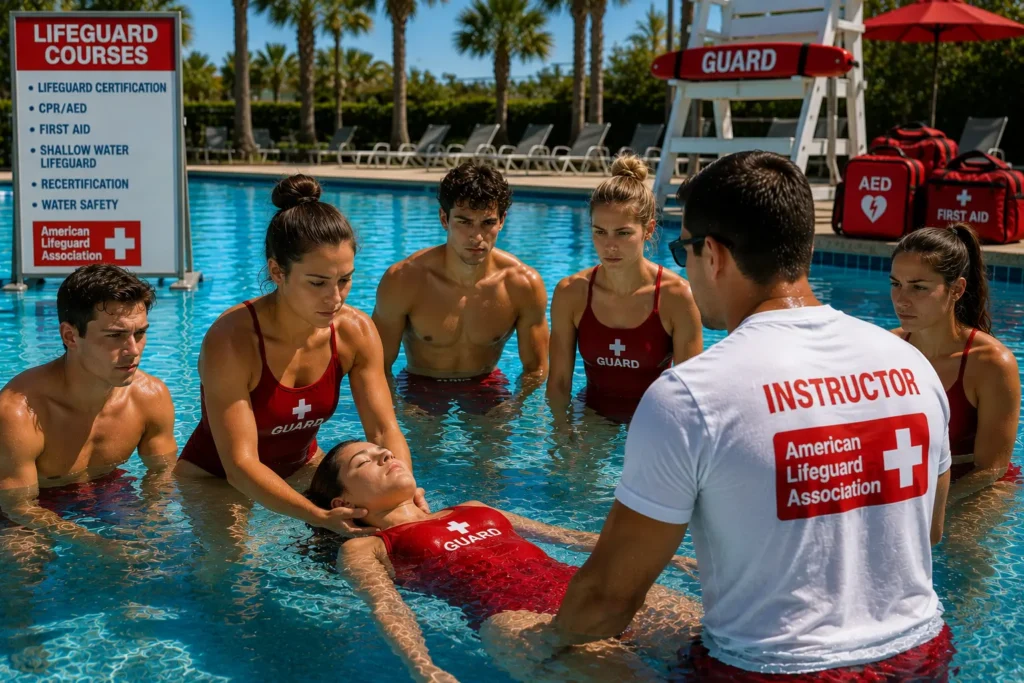
A shallow water lifeguard course is designed for students and employers working in aquatic environments where the water depth and facility design may not require full deep-water lifeguard training. This may include certain pools, shallow water attractions, aquatic play areas, splash facilities, and controlled shallow-water environments.
This course may be appropriate for facilities where lifeguards supervise guests in shallower water and need training focused on prevention, surveillance, rescue response, CPR/AED, First Aid, and facility-specific readiness.
A shallow water lifeguard course may be a good choice for:
Facilities with shallow-water attractions.
Employers with limited-depth aquatic areas.
Students who are not pursuing deep-water lifeguarding.
Aquatic programs with shallow-water supervision needs.
Facilities that need a course aligned with their actual operating environment.
A lifeguard recertification course is designed for lifeguards who already hold certification and need to renew their credentials. Recertification helps lifeguards refresh rescue skills, CPR/AED, First Aid, emergency response, and professional readiness.
Lifeguard skills can decline without regular practice. Rescue techniques, CPR, AED use, victim recognition, and emergency action plan procedures must be reviewed and practiced over time. Recertification helps keep lifeguards current and prepared.
This course is ideal for:
Lifeguards whose certification is close to expiring.
Returning seasonal lifeguards.
Pool staff preparing for a new season.
Employers renewing staff credentials.
Lifeguards who want to maintain readiness.
Renewal should not be delayed until the last minute. Lifeguards should begin the recertification process before their current credential expires.
CPR/AED and First Aid are essential parts of lifeguard training because lifeguards may be the first trained responders during aquatic emergencies. A person rescued from the water may need immediate care before EMS arrives. A pool guest may suffer a medical emergency. A child may be injured on the deck. A swimmer may need emergency breathing or cardiac care.
ALA’s course materials state that the lifeguard training program includes CPR and AED training to assist victims in cardiac emergencies. (American Lifeguard Association)
The CDC Model Aquatic Health Code also identifies CPR/AED and First Aid as important elements within aquatic facility safety, including maintaining certificates and demonstrating rescue and resuscitation skills as part of ongoing readiness. (CDC)
CPR/AED and First Aid courses may be taken as part of a lifeguard certification pathway or as related safety training for individuals, staff, schools, organizations, and aquatic facilities.
Water safety training helps students understand how to reduce risk around pools, beaches, waterparks, lakes, and other aquatic environments. While lifeguard certification prepares someone for a professional safety role, water safety education can benefit a wider audience.
Water safety courses may be helpful for:
Parents and caregivers.
Camp counselors.
Swim coaches.
Teachers.
Youth program staff.
Pool attendants.
Hotel and resort staff.
Community organizations.
Anyone who supervises children near water.
Water safety training reinforces prevention, supervision, hazard recognition, emergency response, and responsible behavior around water.
The American Lifeguard Association offers lifeguard courses in a video instructor-led blended learning format. This format allows students to complete structured academic instruction while preparing for the practical responsibilities of lifeguarding.
Blended lifeguard courses can be especially useful for students, employers, schools, camps, parks and recreation departments, waterparks, resorts, hotels, and aquatic facilities that need flexible training access.
It is important to describe ALA’s model correctly. ALA’s courses should be described as video instructor-led blended learning, not simply “online-only.” Practical competency is addressed within the aquatics environment through employer-based pre-service evaluations and ongoing in-service procedures established to meet CDC Model Aquatic Health Code requirements. These are CDC MAHC requirements and national standards set by the CDC, not requirements created by ALA.
The CDC Model Aquatic Health Code requires aquatic facilities to include pre-service training plans and in-service training plans in their safety plan, and it specifically identifies facility-specific policies and procedures, demonstration of safety team skills before assuming on-duty lifeguard responsibilities, and documentation of training as part of pre-service requirements. (CDC)
This means a lifeguard course provides the training foundation, while the aquatic facility confirms practical readiness in the actual environment where the lifeguard will work.
A strong lifeguard course should cover the full range of knowledge and skills needed for aquatic safety. Students should expect to learn both rescue skills and prevention skills.
Lifeguards must learn how to scan the water, recognize unsafe behavior, enforce rules, and prevent injuries. Prevention is one of the most important parts of lifeguarding because the best rescue is the one that never has to happen.
Students learn how to identify swimmers in distress, active drowning victims, passive drowning victims, submerged victims, tired swimmers, and guests experiencing medical emergencies.
Students learn how to enter the water, approach a victim, use rescue equipment, protect themselves, support the victim, remove the victim from the water, and begin emergency care.
Students learn how to recognize cardiac and breathing emergencies, perform CPR, use an AED, and continue care until EMS or advanced help arrives.
Students learn how to respond to injuries and illnesses that may occur in aquatic environments, including cuts, falls, heat illness, head injuries, allergic reactions, and breathing emergencies.
Students learn why emergency action plans are important and how lifeguards work as part of a safety team during an emergency.
Students learn the importance of focus, punctuality, communication, teamwork, rule enforcement, physical readiness, and continued practice.
Requirements for lifeguard courses can vary depending on the course type, employer, aquatic environment, state, local authority, and facility requirements.
ALA’s public FAQ states that participants must be at least 15 years old by the end of the course and complete the following swim prerequisite:
The complete sequence must be performed without stopping to rest. Participants must also complete a timed event that includes retrieving a 10-pound object from 7–10 feet of water.(American Lifeguard Association)
Federal youth-employment guidance also addresses lifeguard age requirements. The U.S. Department of Labor states that 15-year-olds, but not youth under age 15, may be employed as lifeguards at traditional swimming pools and most water amusement park facilities when required conditions are met, including training and certification by the American Red Cross or a similar certifying organization. The same DOL fact sheet states that youth under age 16 may not be employed as lifeguards at natural environment facilities such as rivers, streams, lakes, ponds, reservoirs, wharfs, piers, or ocean-side beaches. (DOL)
Students should always confirm course prerequisites and employer requirements before enrolling.
8300 Boone Blvd 5th Floor
Vienna, VA 22182
Get Directions & Wayfinding
Completing a lifeguard course is an important step, but employers should still evaluate each lifeguard in the specific aquatic environment where they will work. Every facility has different zones, hazards, equipment, water depths, rescue routes, staffing plans, emergency procedures, and communication systems.
The CDC Model Aquatic Health Code states that pre-service requirements include facility-specific policy and procedure training, demonstration of safety team skills specific to the aquatic facility before assuming on-duty lifeguard responsibilities, and documentation of training. It also states that aquatic facility staff must participate in periodic in-service training to maintain skills. (CDC)
Employer-based evaluation may include:
Reviewing the facility’s emergency action plan.
Identifying surveillance zones.
Practicing rotations and communication.
Locating rescue equipment, First Aid kits, AEDs, and emergency supplies.
Demonstrating water rescue skills.
Demonstrating CPR/AED and First Aid readiness.
Reviewing patron rules and enforcement expectations.
Participating in emergency drills.
Documenting pre-service and in-service training.
This process helps ensure that lifeguards are not only course-complete, but also prepared for the actual facility where they will work.
Choosing the right lifeguard course depends on your goal. A first-time lifeguard may need a full certification course. A returning lifeguard may need recertification. A student working in shallow water may need shallow water lifeguard training. An employer may need group training.
Before enrolling, ask these questions:
Are you becoming a lifeguard for the first time?
Are you renewing an existing certification?
Will you work at a pool, waterpark, beach, camp, school, or resort?
Do you need deep-water or shallow-water training?
Does the course include CPR/AED and First Aid?
Does your employer accept the certification?
Will the employer provide facility-specific pre-service evaluation?
Can your certification be verified?
Does the course format fit your schedule?
The best lifeguard course is the one that matches the job, the facility, and the student’s readiness level.
Many students search for “lifeguard courses near me” because they need a course for employment, school, camp, summer work, or recreation department hiring. The American Lifeguard Association’s flexible training pathway helps students begin the process without being limited to a single local class date.
ALA’s website states that with its training program, students do not have to wait for a group class, and that training programs can be taken anywhere. (American Lifeguard Association)
When looking for lifeguard courses near you, consider more than location. The closest course is not always the right course. Look for a course that includes lifeguarding, CPR/AED, First Aid, rescue skills, emergency response, and a clear path toward certification and employer-based practical evaluation.
Lifeguard courses are popular with high school and college students because lifeguarding can be an excellent first job. It teaches responsibility, discipline, leadership, communication, public safety awareness, and emergency response.
Students who complete lifeguard courses may be able to apply for work at:
Swimming pools.
Waterparks.
Summer camps.
Schools.
Hotels and resorts.
Community recreation centers.
Country clubs.
Fitness centers.
Apartment and condominium pools.
Lifeguarding is more than a summer job. It can also be a first step toward careers in aquatics, recreation management, emergency services, healthcare, coaching, education, and public safety.
Aquatic facilities depend on trained lifeguards. A pool, waterpark, camp, or resort cannot operate safely without a prepared safety team. Lifeguard courses help employers develop qualified candidates and maintain staff readiness.
Employers should view lifeguard courses as part of a larger safety system. A complete safety system includes:
Certification training.
Facility orientation.
Pre-service evaluation.
Emergency action plan drills.
In-service training.
Credential verification.
Supervision and documentation.
Ongoing skill maintenance.
The CDC Model Aquatic Health Code includes safety plan elements such as staffing plans, emergency action plans, pre-service training plans, and in-service training plans. (CDC)
That structure helps employers understand that lifeguard training is not a one-time event. It is an ongoing safety responsibility.
Credential verification is important for both students and employers. Students need access to their records, and employers need confidence that a certification is current and accurate.
ALA states that it uses Universal Lifeguard Certification to verify the credentials of ALA lifeguards. ALA’s website explains that ULC allows lifeguards to manage professional credentials online and offers validation services for certifications. (American Lifeguard Association)
Credential verification can help with:
Employment applications.
Renewal planning.
Employer review.
Staff recordkeeping.
Proof of course completion.
Reduced confusion over missing or expired credentials.
A lifeguard course is most valuable when the resulting credential can be clearly verified.
The American Lifeguard Association has been offering lifeguard courses for over 35 years and states that its mission is to improve the quality and accessibility of health and safety programs to the public. (American Lifeguard Association)
Students and employers choose ALA courses because they provide a practical pathway for aquatic safety training and certification. ALA courses support lifeguarding, CPR/AED, First Aid, water rescue, injury prevention, emergency preparedness, and professional readiness.
ALA courses offer:
Video instructor-led blended learning.
Lifeguard certification pathways.
CPR/AED and First Aid training.
Shallow water lifeguard training options.
Recertification options.
Individual and group training support.
Credential verification through Universal Lifeguard Certification.
A practical model that recognizes employer-based pre-service evaluation and ongoing in-service training.
ALA’s purpose is to help candidates gain the knowledge and skills needed to help prevent and respond to aquatic emergencies. (American Lifeguard Association)
Yes. ALA’s public FAQ states that its lifeguard classes program covers swimming and rescue skills, CPR/AED, First Aid, and injury prevention techniques. (American Lifeguard Association)
ALA’s public FAQ states that upon successful completion, participants receive certifications in Lifeguarding, CPR/AED, and First Aid, valid for two years. (American Lifeguard Association)
Join thousands trained by the American Lifeguard Association. Nationally recognized certification, backed by 30+ years of experience.